

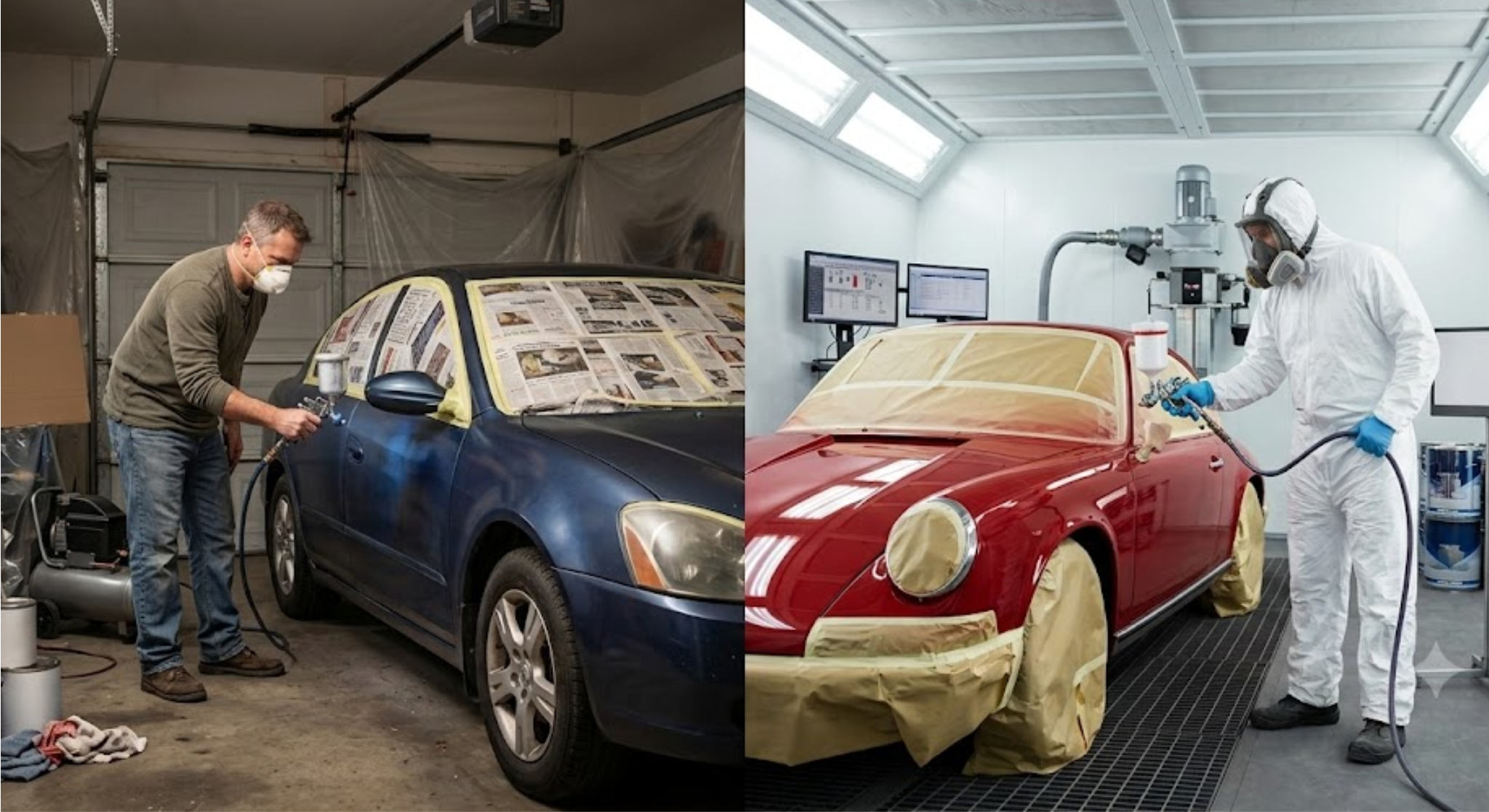

Achieving a flawless, showroom-grade finish on a vehicle is one of the most satisfying parts of an automotive restoration or repair project. At the very center of any multi-stage paint job is the base coat the crucial layer that delivers rich color saturation, metallic flake alignment, and exact shade matching before being sealed under a protective clearcoat.
Whether you are fixing a rusted fender, repainting a classic muscle car, or touching up daily driver road wear, you face a major decision: should you attempt a Do-It-Yourself (DIY) application in your home garage, or outsource the job to a professional collision center?
While taking the hands-on approach can save money up front, DIY and professional applications have different outcomes. Understanding the differences in equipment, environment, surface preparation, and overall cost helps you choose the right path for your Base Coat Paint for Cars project.
1. Environment Control: The Cleanliness Factor
The single biggest obstacle facing any DIY painter is environmental contamination. Base coat paint dries quickly, but until it flashes off, it acts as a magnet for airborne debris.
┌─────────────────────────────────────────────────────────────────────────────┐
│                    ENVIRONMENTAL CONTROL COMPARISON                         │
├──────────────────────────────┬──────────────────────────────────────────────┤
│ Environment Type             │ Common Contaminants & Challenges            │
├──────────────────────────────┼──────────────────────────────────────────────┤
│ **Home Garage (DIY)**        │ Dust, floating lint, insects, humidity shifts,│
│                              │ and static electricity pulling debris.       │
├──────────────────────────────┼──────────────────────────────────────────────┤
│ **Down-Draft Booth (Pro)**   │ HEPA-filtered air intake, heated curing      │
│                              │ lamps, and controlled laminar airflow.       │
└──────────────────────────────┴──────────────────────────────────────────────┘
- The DIY Reality: Spraying in a residential garage or makeshift plastic booth often results in dust nibs, bugs, or airborne lint settling into the wet base coat. While minor dust specks in clearcoat can be wet-sanded out later, debris trapped in the underlying base coat disrupts metallic flake orientation and requires scuffing and re-spraying the entire panel.
- The Professional Advantage: Professional body shops utilize heated, positive-pressure down-draft spray booths. These controlled environments continuously pull fresh, HEPA-filtered air downward across the vehicle, sweeping overspray and dust particles away from wet paint panels instantly.
2. Equipment Precision: Air Delivery and Spray Guns
Applying base coat evenly requires fine, consistent paint atomization. The physical tools used in the process directly dictate how smoothly the paint lays down on the panel.
[ Air Compressor Output ] ──► [ Filtration & Moisture Traps ] ──► [ HVLP Atomization ]
The DIY Gear Setup
Home mechanics typically use smaller pancake or mid-sized 20-to-30-gallon air compressors paired with budget High-Volume Low-Pressure (HVLP) spray guns.
- The Risk: Small compressors struggle to maintain continuous CFM (cubic feet per minute) airflow required for long spray passes. As pressure drops mid-pass, gun atomization degrades, leading to uneven paint droplets, orange peel texture, or metallic pooling. Additionally, inadequate air line moisture traps can allow water droplets into the air line, causing fish-eye crater defects.
The Professional Gear Setup
Commercial shops utilize industrial screw-drive compressors equipped with refrigerated air dryers and multi-stage desiccant filters. Paired with precision-calibrated professional HVLP spray guns, technicians achieve razor-sharp fan pattern control, consistent fluid delivery, and zero oil or moisture contamination.
3. Surface Preparation and Color Matching
Even the highest-quality base coat paint will fail prematurely if applied over poor foundation work. Surface prep consumes up to 80% of total labor time in professional paint refinishing.
[ Block Sanding & Filler ] ──► [ Sealer Application ] ──► [ Spectrophotometer Color Match ] ──► [ Base Coat Pass ]
- DIY Color Matching: Ordering pre-mixed color code paint online works reasonably well for basic solid shades. However, factory paint code formulations do not account for natural UV fading, weathering, or batch variations on aged vehicles. DIYers often struggle to blend new base coat seamlessly into adjacent original panels without leaving hard edge lines.
- Professional Color Matching: Professional refinishers use computerized spectrophotometers to scan the vehicle’s existing paint directly. The system formulates a custom-tinted variant that accounts for age and fade. Technicians then utilize feathered panel blending techniques, fading the new base coat gently across neighboring panels so the repair becomes invisible under clearcoat.
4. Cost vs. Quality Comparison
Understanding the real financial commitment of DIY vs. professional painting requires looking beyond the price of the paint tin itself.
| Application Factor | DIY Garage Application | Professional Body Shop |
| Upfront Financial Cost | Low to Moderate ($200 – $600 in supplies/tools). | Moderate to High ($800 – $3,000+ per job). |
| Equipment Investment | Requires buying compressor, guns, PPE, and filters. | Fully equipped with industrial booths and tools. |
| Time & Labor Required | High; steep learning curve and extensive prep time. | Low personal effort; turnkey service provided. |
| Warranty & Longevity | Zero warranty; mistakes must be fixed out-of-pocket. | Includes labor/material warranties against peeling. |
| Finish Consistency | Variable; higher risk of mottling or dust nibs. | Showroom quality; precise metallic flake orientation. |
5. Personal Safety Considerations
Automotive paints, reducers, and clearcoats contain volatile organic compounds (VOCs) and hazardous solvents that require strict safety protocols:
- Respiratory Protection: Spraying base coat requires at minimum a properly fitted NIOSH-approved dual-cartridge respirator rated for organic vapors.
- Skin & Eye Shielding: Isocyanates present in two-stage paint hardeners and clearcoats can absorb through skin and eyes, requiring full paint suits, nitrile gloves, and eye protection.
- Ventilation Safety: Household garage fans are rarely explosion-proof; atomized solvent vapors can pose fire hazards if exposed to pilot lights or open motor brushes.
Conclusion: Making the Right Choice for Your Project
Deciding between DIY and professional base coat application comes down to your project goals, available tools, and budget expectations.
- Choose the DIY Route if: You enjoy hands-on learning, own or plan to invest in proper compressor gear, are working on a track car or daily driver where minor imperfections are acceptable, and want to keep initial labor costs low.
- Choose Professional Application if: You are painting a high-value show vehicle, demand invisible panel blending, require guaranteed color accuracy on a late-model car, or lack the space and safety equipment needed to handle chemical solvents safely.
Whichever path you choose, starting with a premium-grade Base Coat Paint for Cars ensures rich pigment density, excellent coverage, and a lasting foundation for your clearcoat.
Frequently Asked Questions (FAQ)
Q: Can I use aerosol spray cans for DIY automotive base coat repairs?
A: Custom-mixed aerosol base coat cans can work for small spot repairs, mirror caps, or minor trim pieces. However, for large panels like hoods or doors, spray cans lack the continuous fan width and pressure control necessary to avoid uneven metallic striping.
Q: How long should I wait between base coat passes?
A: Most base coats require a “flash-off” period of 5 to 15 minutes between coats at room temperature (70°F / 21°C). The paint should turn from glossy to a uniform dull matte finish before applying the next coat.
Q: What happens if I wait too long to apply clearcoat over base coat?
A: Base coat has a maximum “recoat window” (typically 24 hours). If clearcoat is not applied within this window, the base coat skin hardens and loses its ability to chemically bond with the clearcoat, which can cause future peeling.